

Retaining & rock walls
Retaining & Rock Walls on the Sunshine Coast
Rock and block walls that hold the ground where you want it, with the base and drainage behind them done right the first time.
- Free on-site quotes
- Rock and block walls
- Noosa to the hinterland
- Sunshine Coast owned
- Free on-site quotes
- Structural & softscape
- Noosa to the hinterland
What's involved
The wall you see is the easy part
A retaining wall holds back a lot of weight: soil, water, sometimes a driveway or a pool. Walls that lean or bulge rarely fail because of the rock or block on the face. They fail because of what's behind it, like no proper base, no drainage, and water building up with nowhere to go.
So every wall starts below ground: a solid base, drainage behind the wall so water can get out, and backfill that won't hold moisture against it. Then the face goes up in natural rock or block, whichever suits the yard.
Walls usually go hand in hand with the rest of the yard. Levelling a sloping block for lawn, terracing a garden or cutting in a flat pad for a hut all start with a wall. That's why most of our jobs start with a wall or a footing and finish with turf going down.
- Rock retaining walls
- Block walls
- Retaining wall design
- Stonemasonry
- Concrete masonry
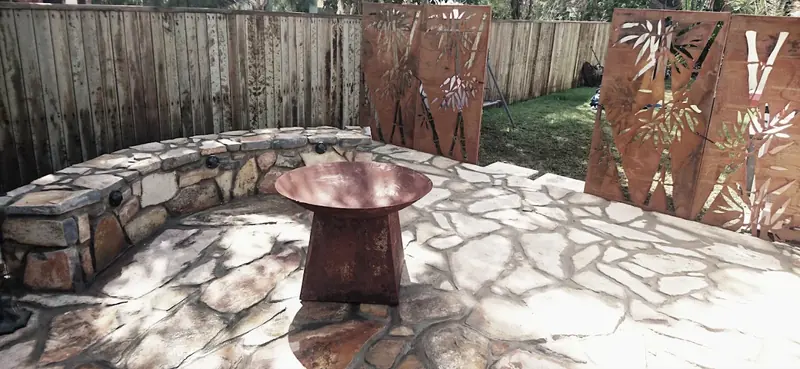
- Stone seat walls
What's included
What goes into a wall that lasts
The parts you'll never see once it's backfilled are the ones that matter most.
A proper base
Excavated and compacted, so the wall sits on solid ground rather than loose fill.
Drainage behind the wall
Free-draining material and a drain line behind the face, with weep holes where the wall needs them.
Rock or block face
Natural rock for a softer, garden look, or block for a crisp, straight line.
Backfill and finish
Compacted backfill, levels checked, and the ground above ready for turf, garden or paving.
Every build, same process
How a wall goes in
Set out
Heights, lengths and levels marked out, with a plan for where the water will go.
Structure up
Excavation, base in, drainage laid, then the wall goes up course by course.
Finished
Backfilled, compacted and cleaned up, ready for whatever goes on top.
Local notes
Retaining walls near you
Building in one of these areas? Here's what to know locally.
Other services
Common questions
Retaining wall questions
Straight answers. For anything specific to your yard, a free on-site quote is the quickest way to know.
Do I need council approval for a retaining wall in Queensland?
For lower garden walls, usually not. Generally, walls over one metre high, or walls close to a house, a driveway or another wall, need engineering and a building approval in Queensland.
The exact rules depend on the wall and the site, so it's worth confirming before anything is dug. It's one of the first things to sort out at the quote.
Rock or block: which is better for a retaining wall?
Neither is better across the board. Natural rock suits sloping, garden-style yards and softens a big level change. Block gives a cleaner, straighter line and suits modern houses and tight boundaries.
Both need the same base and drainage behind them, and that is what decides how long the wall lasts.
Why is my retaining wall leaning?
Usually it's water. Without drainage behind it, water builds up in the soil and pushes on the wall until it moves. A shallow or poorly compacted base is the other common cause.
Depending on how far it has moved, it may need rebuilding rather than patching. We can come and take a look.
Can you build retaining walls on a steep block?
Yes. Steep blocks are where walls earn their keep, terracing a slope into level areas for lawn, garden or a hut. Access for machinery and materials is the main thing we look at on site.
Built to last
Got a slope that needs sorting?
Give us a ring and we'll come and have a look. Quotes are free.
0401 011 576